
Everyone is talking about AI. Almost nobody understands how far ahead it already is. The gap between what people think is possible and what is actually possible right now is the largest it has been in human history.
I've spent the last 6 months going deep on AI. Building with it, advising companies on it, stress-testing what's actually possible versus what's hype. The last 4 weeks alone have made the previous 5 months feel like the stone age (largely thanks to Anthropic's unbelievable Claude Code and Cowork products). The pace of improvement is not linear. It's not even exponential in the way we casually throw that word around. It's a step function, and we just climbed another one.
Here's a small example that made the shift real for me.
I exported my Apple Health data. 7 years of it. 1.13 million heart rate readings, 1,184 GPS-tracked routes, VO2 Max, HRV, sleep, steps, running biomechanics. A 200MB XML file that has been sitting on Apple's servers, doing essentially nothing for me beyond the basic charts in the Health app.
I dropped it into Anthropic's Claude Cowork, their new desktop tool, and in a single conversation, without writing a line of code myself, it:
→ Parsed all 1.13M heart rate records and identified my true max heart rate (200 bpm — Claude informed me that the 206 bpm measurement was likely an outlier) across 7 years of data. Something Strava has been asking me to manually input with no suggested value.
→ Built a full cardiovascular fitness dashboard with VO2 Max trends, resting heart rate, HRV, heart rate recovery, running pace analysis, sleep patterns, and daily steps. All interactive with hover tooltips.
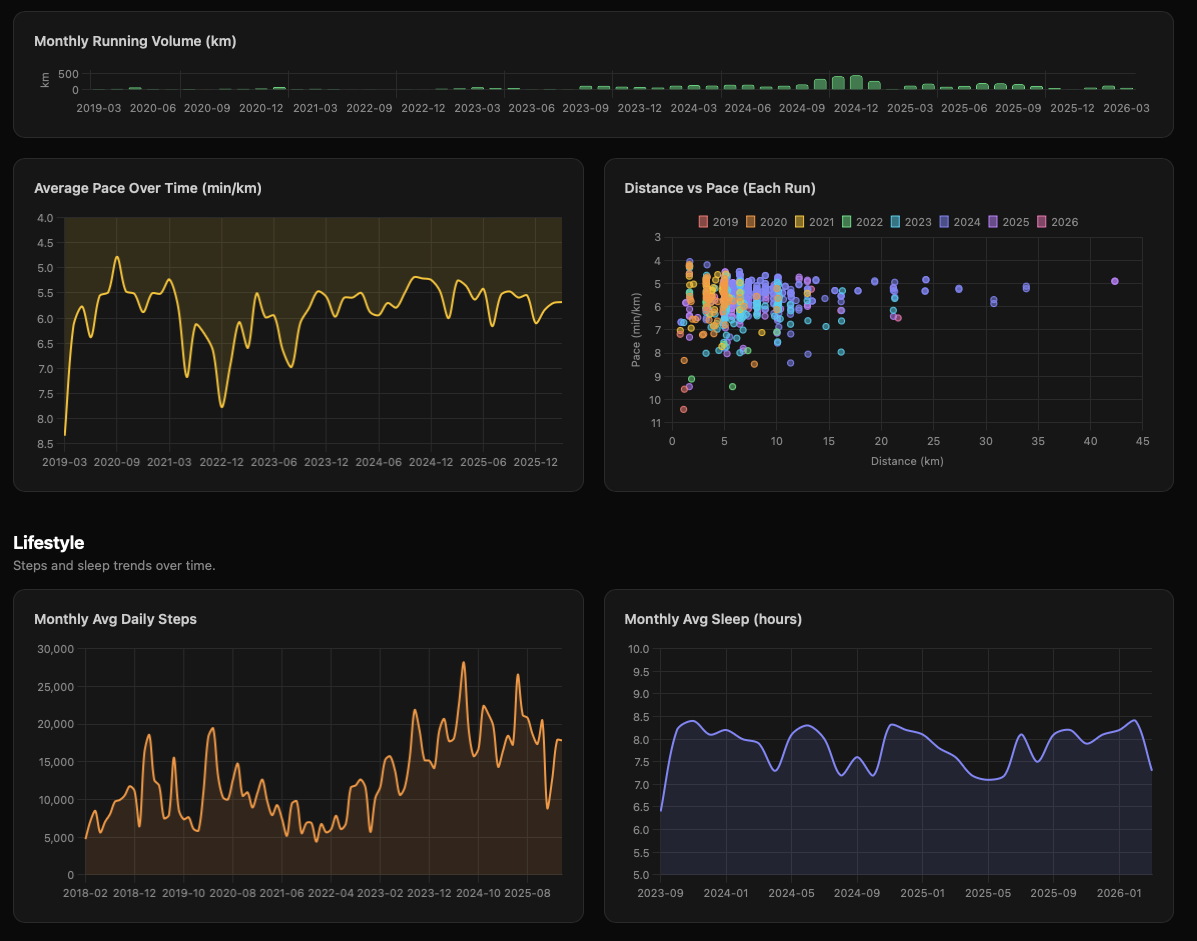
Claude-generated health dashboard
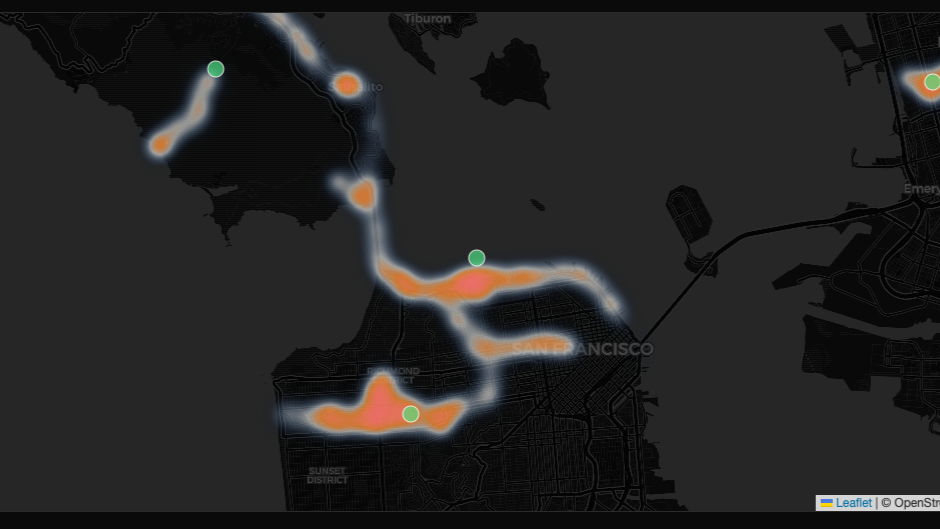
→ Processed 1,184 GPX route files, computed distances, paces, and elevation for each, clustered them by geography, and generated an interactive heatmap showing every place I've ever run. Dallas to Palo Alto to Houston to Ithaca.
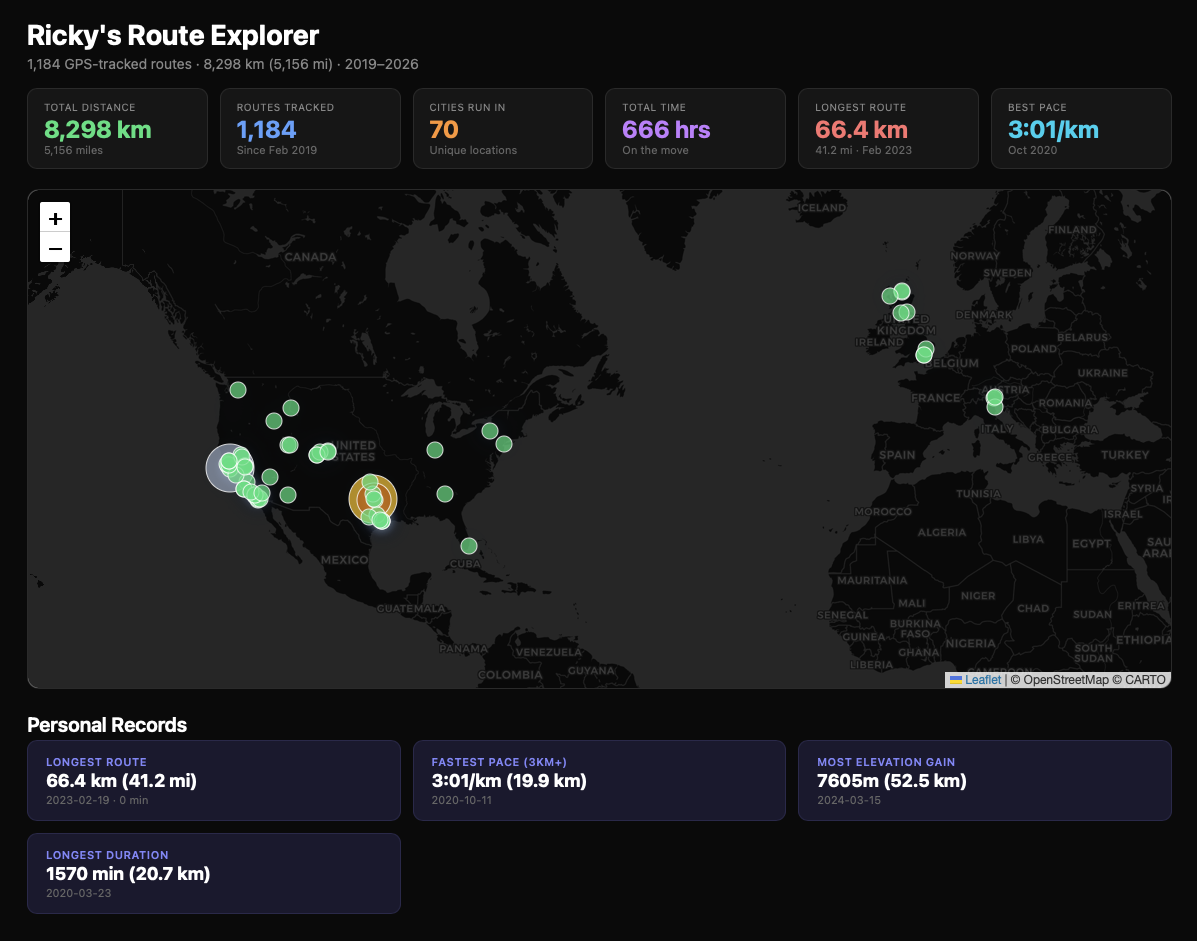
Claude-generated route explorer
→ Created a route high score table with favorite locations ranked by volume, total distance, best pace, elevation gain, and active date ranges.
Two fully interactive dashboards. Built from raw XML and GPX files. In minutes. No pandas import. No Jupyter notebook. No Stack Overflow tabs. Just a conversation.
This is where it gets interesting, and where I think the implications go far beyond one person's running data.
The LLM Is Becoming the OS
We are witnessing the early stages of a fundamental shift in how we interact with our own data. Today, your phone collects an extraordinary amount of information about you. Heart rate, location, sleep, movement, screen time. And then it locks it behind rigid, pre-designed UIs. Apple Health gives you the charts Apple decided you should see. Strava gives you the metrics Strava decided matter.
But what if the operating system itself was an LLM? What if instead of opening an app and navigating to a specific screen, you just said "show me how my resting heart rate correlates with my sleep quality over the last 6 months" and it built the visualization on the fly, exactly how you needed it? That's not a 5-year prediction. That's what I just did, today, with a general-purpose AI tool and a folder of raw data.
The trajectory is clear: phones and computers are moving toward LLM-centric operating systems where the interface is the conversation, and the data you generate becomes infinitely more accessible, queryable, and useful. Apple Intelligence, Google Gemini in Android, Copilot on Windows — these are the first tentative steps. But the destination is a world where pre-built app UIs are the exception, not the rule.
What This Means for Companies Like Strava
If I can go from raw Apple Health export to a better, more personalized running dashboard than Strava gives me, in a single AI conversation, what exactly am I paying Strava for?
The answer, and this is critical for anyone thinking about competitive moats in the AI era: community. Strava's real value is the social graph. It's the kudos, the segment leaderboards, the ability to see what your friends ran this morning. That's the one thing an LLM operating on my local data alone cannot replicate.
But here's the strategic tension: if the analytics and visualization layer becomes commoditized by AI (and it will), Strava's moat narrows to pure social. That's a defensible position, but only if they lean into it aggressively. They should be thinking about how to make the social experience so deeply embedded in the running experience that the dashboard becomes secondary. Think less "fitness tracker with a feed" and more "running community with analytics attached." (Will we see more Strava sponsored events? I would bet my money on it).
Any fitness tech company that thinks their moat is data presentation, analytics, or training advice is about to have a very uncomfortable board meeting.
The Broader Implications
A few things this experience made me think about:
Data portability just became a real threat. Whether it's GDPR in Europe, CCPA in California, or just Apple's export button, we've had the theoretical right to take our data with us for years. Nobody did, because a 200MB XML file is useless to most people. AI changes that calculus completely. The "right to data portability" now has teeth, because a general-purpose AI can turn any raw export into something more useful than the original app. Every company sitting on user data and competing on presentation layer is exposed.
The "analyst" role is being redefined. If you are on X or Instagram you will see an endless feed of folks preaching the Claude Code and Cowork gospel, but the reality is that 99% of companies have no idea what is possible now and what is coming very soon. I didn't write code. I didn't clean data. I didn't choose chart libraries. I described what I wanted in plain English, and got production-quality interactive dashboards. The skill that mattered was knowing the right questions to ask, not knowing Python or D3.js. The analyst of the future is a domain expert who can think clearly about what matters, not a technician who can wrangle dataframes.
This goes way beyond health data. Think about what sits inside the average enterprise: a CRM full of customer interactions nobody has time to pattern-match across, an ERP with years of procurement and inventory data locked behind rigid reports someone built in 2019, financial systems where the only people who can answer ad hoc questions are the two analysts who know where the data lives. Every one of these systems is the enterprise equivalent of my 200MB Apple Health XML — vast, rich, and dramatically underutilized because the interface sits between the user and the insight.
Now imagine a portfolio company CFO who can say "show me which customers have had declining order frequency over the last 3 quarters, cross-referenced with margin by product line" and get an interactive dashboard in minutes instead of a 2-week analytics request. Or an operating partner who drops a CRM export into a conversation and gets a pipeline health diagnostic that would have taken a consultant a week to build.
The companies that win in this environment won't be the ones with the best dashboards. They'll be the ones with the cleanest data, the most integrated systems, and the organizational willingness to let people actually interrogate their own information. Data infrastructure just became a strategic asset in a way that's viscerally obvious, not just a line item the CTO argues for at budget season.
We are at the very beginning of this. The tools are already here. The question isn't whether AI will change how we interact with our own data — it's whether you're realizing the benefits in your organization today. The gap between companies that rapidly adopt AI tools and those that are laggards is already huge, and it's going to grow exponentially.
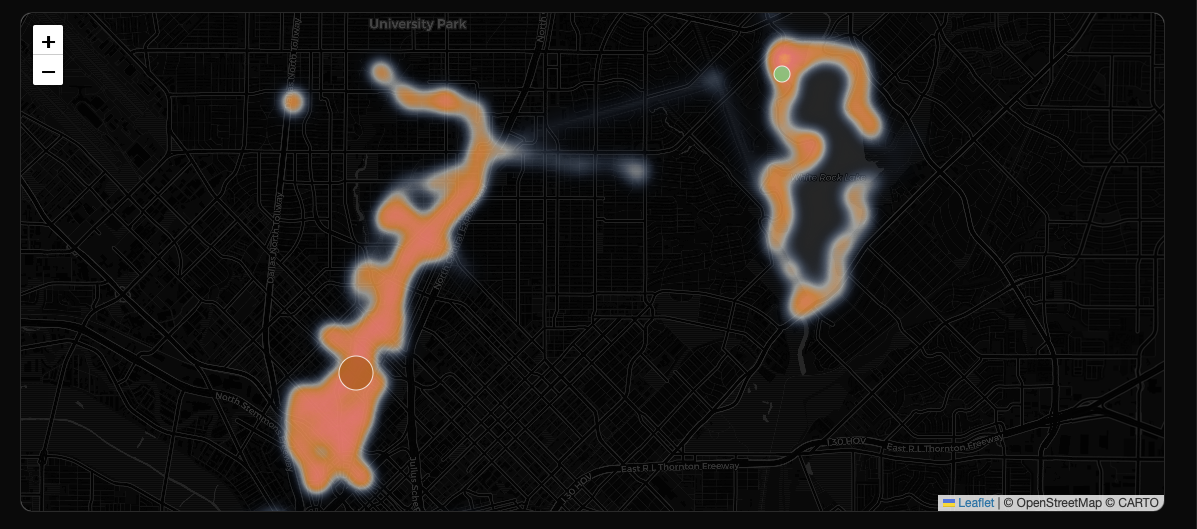
Dallas running heatmap